
What Is Recipe Scaling?
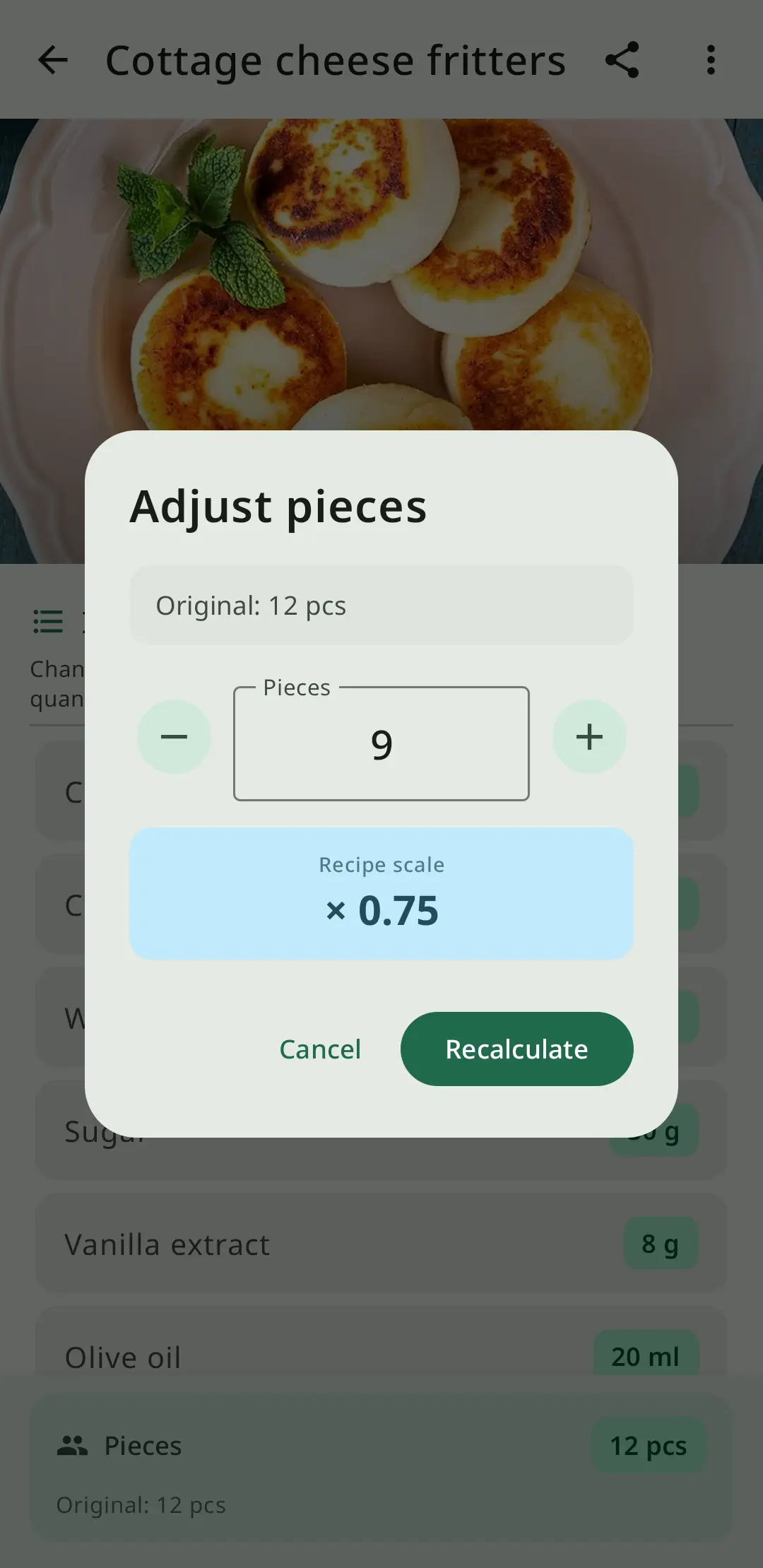
Recipe scaling means adjusting the ingredient quantities in a recipe proportionally to produce a different number of servings. The mathematical foundation is a single ratio: scaling factor = target yield ÷ original yield.
Every ingredient is multiplied by this factor. If the original recipe makes 6 servings and you want 9, the scaling factor is 1.5 — and every ingredient amount is multiplied by 1.5.
A recipe scaler automates this process. Instead of calculating each ingredient individually, you enter the desired serving count and the app recalculates everything at once.
When to Scale Up vs. Scale Down
Different cooking scenarios call for different scaling approaches:
Scaling Up (Making More)
Common reasons to scale up: cooking for a dinner party, preparing food for an event, batch cooking for meal prep, making gifts (jam, bread, cookies), or cooking a large holiday meal. Scaling up is usually straightforward for most cooking recipes. Baking recipes require more care with leavening agents at high multiples.
Scaling Down (Making Less)
Common reasons to scale down: cooking for one or two, testing a new recipe before committing to a full batch, using a limited ingredient quantity, or reducing a recipe designed for a larger household. Scaling down can create challenges with small quantities — fractions of eggs, tiny amounts of spices — which require judgement rather than pure math.
Practical Tips for Accurate Recipe Scaling
Beyond the math, successful recipe scaling requires understanding how recipes work:
- Use weight, not volume. Scaled-down quantities like 'one-third of a cup' are hard to measure accurately. Converting to grams first, then scaling, gives cleaner results.
- Scale leavening carefully. For baking recipes scaled up by more than 2×, use 75–90% of the mathematical leavening amount to avoid soapy or metallic flavors.
- Don't scale cook time or temperature. These depend on pan size and heat transfer, not ingredient quantity.
- Taste as you go. Spices and seasonings may need adjustment after scaling. Salt especially benefits from taste-testing rather than strict mathematical scaling.
- Check pan size. Scaling a recipe up 2× but using the same pan changes the depth of the batter and the cook time significantly.
Recipe Scaler vs. Recipe Calculator vs. Recipe Multiplier
These terms are often used interchangeably, with slight nuance:
- Recipe scaler: A general tool for scaling in either direction — up or down.
- Recipe calculator: Often implies a broader tool that also handles unit conversion and potentially nutrition calculation alongside scaling.
- Recipe multiplier: Specifically implies scaling up — making more of something.
- Recipe divider: Specifically implies scaling down.
RecipeFlow functions as all four simultaneously. The same interface handles multiplying, dividing, and arbitrary scaling (e.g., from 6 to 10 servings), with unit conversion included.